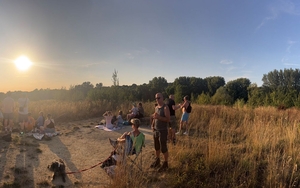












Jonathan Schofield mourns the passing of one of Manchester's great characters and tells other stories as well
Pat Karney leaves the Manchester stage
As has been widely reported, Councillor Pat Karney has died. Tributes have poured in, including one from Andy Burnham during Prime Minister’s Questions in the House of Commons.
Anyone who regularly used the city centre knew him; many who visited less often knew of him. The man, and his ebullient support for his city, will be greatly missed. I will miss bumping into Pat while leading groups from around the world and hearing him hail us. He would ask where people were from, then offer a quip and a smile. His ability to put people at ease was a rare gift.
As a writer, he never obfuscated: he answered direct questions directly. To borrow a House of Commons analogy, he was the Father of the House of Manchester politics, having served as a councillor since 1979. Of course, he divided opinion: some people did not get on with him, while others regarded him as a motormouth. In that respect, he resembled a very different Manchester figure, the controversial and wonderful broadcaster and music impresario Tony Wilson. Karney was, in effect, Wilson’s council counterpart in his advocacy for the city.
Cheeky Pat Karney
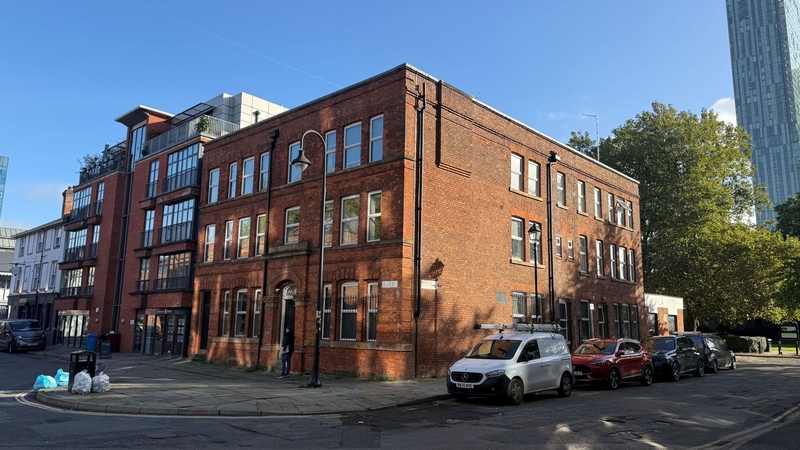
“Do you know what that building used to be?” Councillor Pat Karney asked me in 2007. I was leading a tour of Castlefield for Manchester Confidential after we had written about how rundown this jewel in the city’s crown had become. I had arranged the tour to highlight the problems, and it was clearly going to be an occasion on which Manchester City Council came in for criticism.
The building he meant was so anonymous that I had never included it on a Castlefield tour. “No, I don’t know what that building is,” I said. He had that familiar twinkle in his eye and the beginnings of a grin. “That was St Luke’s,” he said. I looked at him. “Go on, Pat, don’t keep us guessing. I don’t know what St Luke’s was.” In front of 30 people, their jaws dropping, he replied: “It was the ‘clap clinic’, the VD clinic. Went there a couple of times.”
The articles and tour led to a meeting in one of the State Rooms at Manchester Town Hall hosted by Sir Richard Leese and Sir Howard Bernstein and led to the creation of residents and businesses group, The Castlefield Forum.
Everybody who knew him has a Pat story.
As a strange coda to this story is that St Luke's is now flats. I wonder if the residents know it was the 'clap clinic'. Maybe they have a laugh about it.
A tribute from Joan Davies, former Labour councillor and colleague
This is typical of how people are feeling. Joan picks out that quality of being relate to people and says: “I've known Pat Karney for 20 years, only 40% of his time as a major influence on Manchester politics and Manchester life. Alongside the Mr Christmas image and the reminders of his brave, early and timely championing of gay rights in Manchester, he was a great friend to Castlefield, helping to set up Castlefield Forum and then stepping back so that the community could run it. In my 14 years as a City Centre-Deansgate Labour Councillor I encountered a further side to Pat: his unfailing support for Councillors, collectively and individually. You could talk to Pat about any problem impacting your work as a Councillor and know that you would be fully heard with empathy, in confidence, and then provided with practical support and the tools to move forwards.”
Pat, the man of superlatives
Many will remember him for his exuberant descriptions of Manchester events. They provoked some people but, ye gods, they also generated plenty of coverage. With that twinkle in his eye, Pat would declare that Manchester’s Christmas Markets were the best and biggest in the world, outstripping anything in Germany. He would say that Sydney envied the New Year fireworks at the Town Hall and that Manchester Day, which he created, was the greatest city celebration on the planet. A wry claim that Rochdale Road was like the Champs-Élysées was typical Pat provocation.
He was proud of his Irish roots and strongly supported the St Patrick’s Day parade and its surrounding events. Yet he was equally enthusiastic about creating St George’s Day celebrations in the city.
He also wrote beautifully. One day in 2013, he rang to ask whether he could write a column about Margaret Thatcher’s death. Given his staunchly socialist politics, I thought the idea odd. The resulting article was excellent and opened with two killer lines: ‘I have agonised about this for years but I've decided it's time to come out of the closet. I had dinner with Margaret Thatcher.’ The full article is here, and it may not be what you expect.
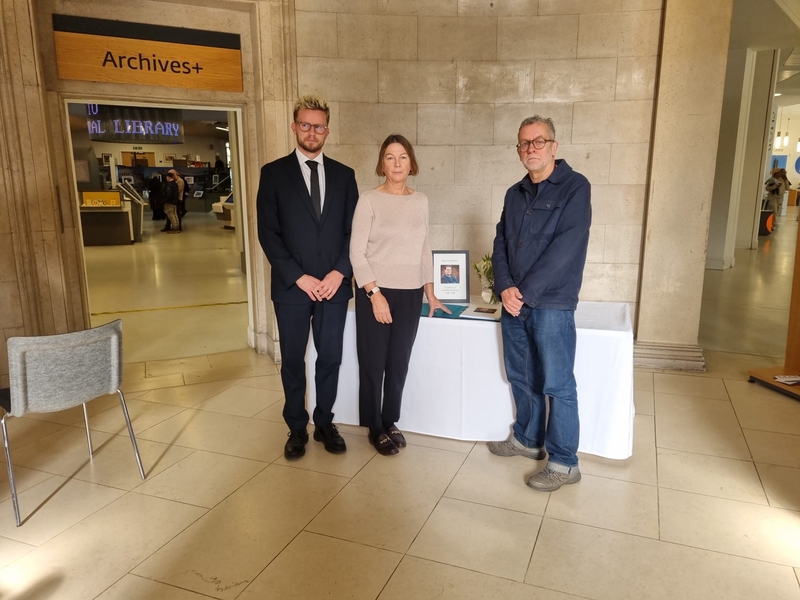
There is a book of condolence in Central Library which anybody can sign for a man who will be missed by many. Council Leader Garry Bridges is pictured here with others.
Milling about just like all rest
The Manchester Mill magazine is a curiosity. It can break news and hold people to account, as it did with its series on murky dealings at the University of Greater Manchester in Bolton. It can produce good work, but then it lets itself down. Last week, it ran a story about an internal staff survey at Manchester City Council under the shouty headline: ‘Report finds “toxic” harassment and “boys’ club” culture at Manchester council’.
Fair enough, you might think. Even important. But here’s the problem: in every newsletter, The Mill tediously insists that it is better or worthier than other media. Here, however, its approach was exactly the same as that of the Daily Mail and the other publications once known as tabloid newspapers.
The Mill could have led with the fact that only 14% of eligible staff responded and that more than 70% of council employees were satisfied. Anyone who has worked in a large bureaucracy will know this is a respectable result. The council itself acknowledged that it needed to do much better in certain areas of staff welfare and said it would introduce measures to address them. That should have been that; instead, the coverage was all shock, horror and righteous indignation. But the main point is don’t pretend you’re one thing and then be the opposite.
From 10 Tib Lane to the sea
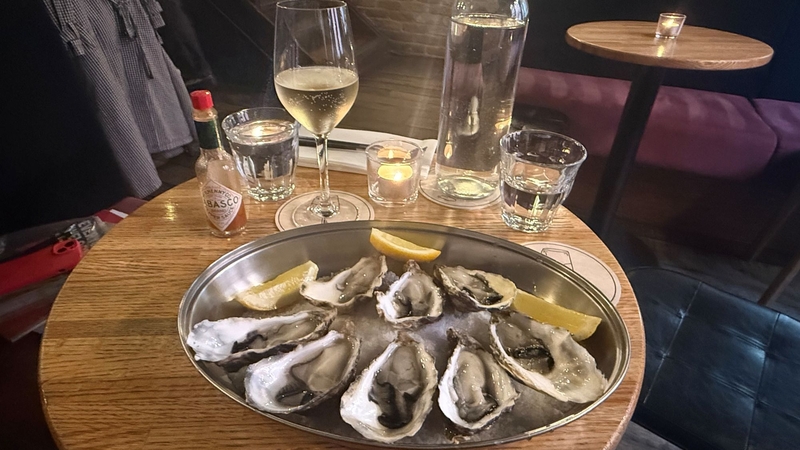
Oysters. Oh, bless — please don’t tempt me. For bivalve lovers, 10 Tib Lane offers a very fine weekday deal. From 4–6 pm, Tuesday to Friday, oysters are £1 each at this elegant little restaurant. It is one of my favourite places and makes for a lush teatime, as the picture below proves. Those with long memories may recall that 10 Tib Lane was once Lounge Ten, led by the pink-kilt-clad Kit, with its raunchy murals and a private-dining-room door handle shaped like a very generous phallus.
By the way, the rest of the food at 10 Tib Lane is fabulous. Alex Shaw’s kitchen produces exquisite modern European dishes. Here’s the menu.
Horsemeat lasagne, anyone?
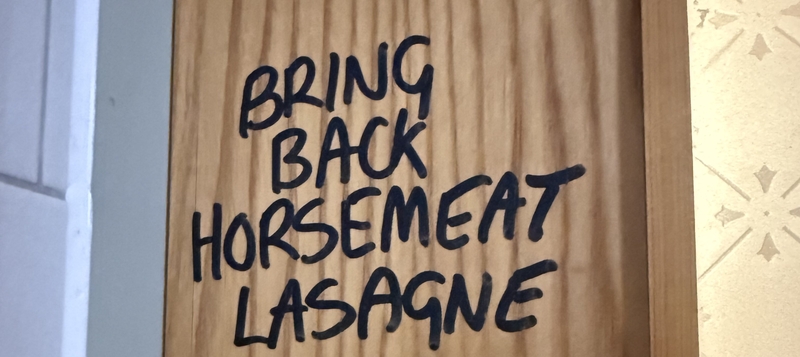
I’m rather fond of absurd graffiti that appears to capture a spontaneous moment of madness. This example is from the Crown and Anchor toilets on Cateaton Street in Manchester. I wonder whether there’s a recipe somewhere. On a recent visit to a small northern Italian town near Lago Maggiore, I noticed a horsemeat butcher’s, maybe they could supply the man asking the question in a Mancunian boozer. I think I’ll stick to oysters.
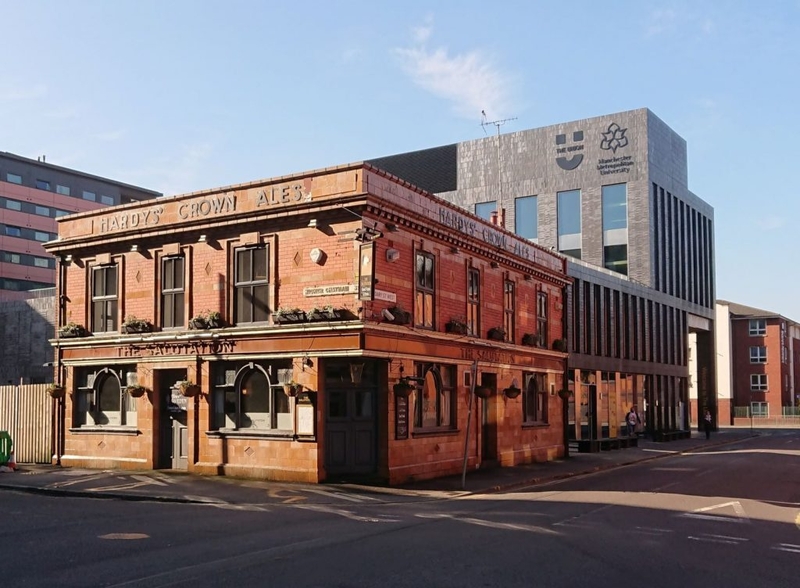
The Salutation is such a lovely pub … but so bad
The Salutation is a tiled gem in All Saints, a classic university-area pub that holds memories for tens of thousands of people. Manchester Metropolitan University Students’ Union has run it since 2013. The pub's website has a strapline that reads: ‘A traditional and homely pub right in the centre of campus, what more could you want?’ What more could we want?
Some drinks, perhaps.
I don’t know what is wrong with the Students’ Union’s logistics, but since reopening the pub it has frequently run out of basic items such as wine or beer. Sometimes it is one, sometimes the other, sometimes both; at other times, it is some equally standard refreshment.
It’s a pub, for Gawd’s sake. Do it right MMU.
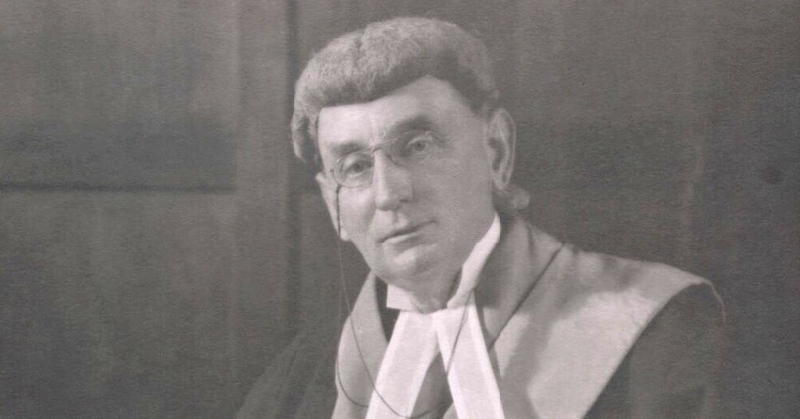
Thanks Judge Parry, that’s kind of you
This week, I took a group of judges around the city. I must look up the collective noun for judges. We had a grand time walking through town, and I mentioned one of my favourite judges from history: Sir Edward Abbott Parry. His autobiography, ‘What the Judge Saw: Being Twenty-Five Years in Manchester by One Who Has Done It’, was published in 1912 and contains one of the finest quotations about the city.
"For Manchester is the place where people do things. It is good to talk about doing things, but better still to do them. Don't talk about what you are going to do it. Do it! That is the Manchester habit, and in the past, through the manifestation of this quality, the word Manchester became a synonym for energy and freedom and the right to do and to think without shackles."
Thank you, Judge Parry. He almost never had the chance to write his autobiography: in what is now Cobden House, but was then the county court, he was shot three times. The next story will tell that tale.
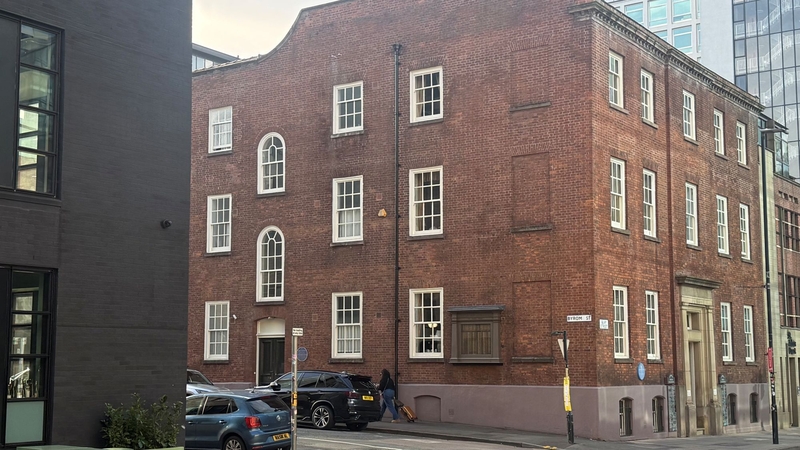
The shooting of Judge Edward Abbott Parry
Cobden House on Quay Street formerly hosted the County Courts and in 1898 a man called William Taylor lost his bailiff’s licence for profiteering from his job. The judge was Parry, who was known as ‘a friend of the poor’. This is from the Manchester Guardian.
‘Exactly what took place may be best told in the words of one who was in court at the time. His story is as follows.
'Swiftly and silently, Taylor crept behind Mr. Keeling, and in another moment was at the side of the judge's chair with a loaded revolver levelled at the head of its occupant. Almost the first intimation that the majority of people in court of anything being wrong was the sharp crack of a revolver, repeated twice again in quick succession. At the same moment, Mr. Thomason, the judge's clerk, sprung from his desk on the right of the chair and grappled with Taylor. Over they rolled upon the bench, and the judge slowly reeled backwards over the right arm of his capacious chair, vainly endeavouring with one hand to cover a quickly reddening wound on the left cheek.
‘The scene that ensued beggars description. Women and men, screamed and shouted with fear, and there was a mad rush for the doorway. Many who had only heard the reports of the revolver imagined doubtless that some sort of explosion had occurred, and feared that the building might come tumbling about their ears.
‘Others, grasping the situation, made their way in the direction of the bench with all possible speed. Meanwhile, Mr. Thomason had borne Taylor to the ground, and was now struggling with him close to the chair of the judge for possession of the weapon. The danger was still imminent, for the revolver was discharged again during the struggle, the bullet whizzing past the heads of Mr. Desquesnes, Mr. Dibb, another legal gentleman, and embedding itself in the wall opposite the bench.
‘Fortunately, the plucky judge's clerk had got a grip of the hand holding the weapon, and Taylor was thus unable to take careful aim. Some of the officers of the court and a few of the public assisted Mr. Thomason to secure the frenzied man and to wrench the revolver from his grasp. Others supported the judge, whose wig and gown contrasted strangely with his ashen face and the blood about his neck. Others rushed about the court like madmen, crying out for a doctor. And my most vivid recollection at this moment is of a learned advocate, his gown flying behind him, dashing towards the door, the obvious intention of summoning a medical man.
‘Fortunately, Mr. Montgomery of the infirmary happened to be within the building, and he reached the judge within a minute or so of the shooting. Assisted by his brother, Mr. Burn, Mr. Thomason, and Mr. Bates, and a few others, the surgeon staunched the flow of blood by means of handkerchiefs and hastily improvised bandages, whilst Taylor, who was still in a wild and frenzied condition, was led away in the custody of the law's representatives.
‘Some excited individuals roundly declared that the man deserved hanging, and Taylor, who possibly heard them, was heard to observe that the officers could take him where they liked and do what they wished with him. He was hurried into another room to await the arrival of Superintendent Caminada.
‘Then the officers cleared the public from the court. The judge was carried into his private room, where he was attended by more doctors who had been hurriedly summoned, Dr Bury, Mr Wright, Dr Roberts, and others. In the court itself, so recently the scene of a tragedy, there remained only a few pale-faced men discussing the exciting event which had occurred, whilst the forgotten wig of some learned counsel lay neglected upon the solicitor's table.’
It’s a proper potboiler of a story. Happily and remarkably, Judge Parry, despite being shot at close range in the cheek, jaw and neck, slowly recovered and was able to resume his duties as a judge again. He was 35 at the time of the attack and he would live until 1943.
William Taylor said he had been driven by ‘satanic voices’. He avoided a hanging but ended up at Broadmoor Hospital, or, to use the plain-speaking of the day, the Broadmoor Criminal Lunatic Asylum, as it was known.
Upcoming Manchester and region tours
Every Saturday, The Manchester Music Walkabout. Sunday 18 October 12noon Secrets of Knutsford. Saturday 31 October 10am The Pan-African Congress, Slavery, and Thomas Clarkson Tour: A Manchester Anniversary Tour. 4pm 6pm 8pm Halloween: The Ghosts of Manchester. Sunday 1 November 11am The Manchester Literary Tour. With Manchester Wire: 5pm Thursday 5 November Manchester's Film & Book Tour.
All the tours are available as private or corporate tours. Tours can be customised to fit exactly the client's needs.

Get the latest news to your inbox
Get the latest food & drink news and exclusive offers by email by signing up to our mailing list. This is one of the ways that Confidentials remains free to our readers and by signing up you help support our high quality, impartial and knowledgable writers. Thank you!

Join our WhatsApp group
You can also get regular updates on news, exclusives and offers by joining the Manchester Confidential WhatsApp group.